Wednesday, November 26, 2008

The Human Eye

The human eye is an amazing component of the body. With it, we can see! Imagine what life would be like if you couldn't see? I wear glasses, and my prescription is rather strong, but I would prefer to retain some vision than none at all!

Our eyes do a lot for us, and we sometimes don't take that into consideration. You can see a loved one's smile...You can enjoy a beautiful summer's sunset...You can drive! Many of the wonderful things we enjoy and need in our lives today can be attributed to our helpful set of eyes.

Being extremely complex in design and function, the human eye is difficult to describe in detail. In essence, our eyes recognize light. Light streams through the pupil and then the lens of the eye. The lens focuses what we see (hopefully) onto the retina, where an inverted image is turned so what we see isn't upside down. The retina is also what gives us the ability to see in colour. Packed with rods and cones, which interpret light and colour respectively, the retina is a vital part of the eye. Problems occurring in the lens cause our vision to be unfocused (myopia and hyperopia).

Imagine performing a nursing procedure without the use of your eyes. Could you take vital signs blindfolded? Change a bandage? Assist in childbirth? Life would be a lot more complicated without our vision!
So, it's important that we take care of our eyes so that we can work effectively and enjoy life in a full range of colour and light.

Photo taken from: http://www.freedomscientific.com/resources/vision-anatomy-eye.asp

Technology crosses barriers in communication...

Technological advances in society improve its methods of communication. We use e-mail, smart phones, pagers, and text messaging to get in touch with people around the word, all the time. Communicative technology, when applied to nursing, is an effective tool in crossing communication barriers.

The Electronic Health Record allows immediate access to patient information over long distances, thus improving the quality and timely delivery of nursing care; nurses are all reading, understanding, and acting on the same information.

Improvements have also been made to improve communication between nursing staff—the use of e-mail, for example. This helps me prepare myself for clinical situations, as I receive information about clients in advance. Technology will help me to communicate effectively with my colleagues and provide better care to my clients. What more could a nurse ask for?! =)

Thursday, October 9, 2008

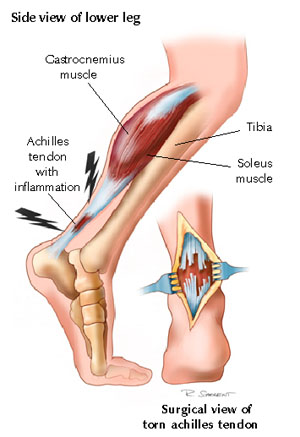
The Achilles Tendon

Anyone who is mildly interested in Greek mythology is familiar with the term "Achilles' heel", and how the great warrior, Achilles' only weakness was in the back of his ankle because he was killed by an arrow directly hitting that spot. Whether or not you put any stock into mythology isn't very important; what is important is recognizing how truly vital the Achilles' tendon is in the human body.

The Achilles' tendon is located in the back of the leg and connects with the underneath of the foot. It's the reason we can stand on our tip-toes and run long distances. Without the Achilles' tendon, we would not be able to perform all of the bending and twisting of the feet.

So we have these amazing tendons in our body, so what? Well just as you can overuse a muscle during exercise, you can injure your Achilles' tendon. An injury to this tendon is not only painful, but it affects all movement of the lower limbs.

An example of this is of a football quarterback who snapped his Achilles' tendon when he moved his foot backward during a game. He was pulled from the game, and asked if he needed an ambulance or ride home. He declined, but found when he got to his car that he could not even use the clutch. He could not push his foot down on it. That's how important and undervalued the Achilles' tendon is.

There are ways to treat injured tendons, but it takes time and patience while enduring pain and limited mobility. So, it is a good idea to consider taking care of your Achilles' tendon! This doesn't mean you can't enjoy running or wearing stilettos, it just means that you have to be careful with how much and how long you strain the tendon.

Check out this link for more information: http://www.pedorthic.ca/public/when_03A.html
Photo taken from: http://www.pyroenergen.com/articles/achilles-tendonitis.htm

Wednesday, October 8, 2008

Elections 2008!

Back again!

As we all realize, election day is about six days away, and now is an important time to be considering which candidate we will vote for. Not only is it important to understand a party's platform, but also to understand the party's decision-making principles.

As part of the nursing community, I think now is a crucial time period during which nurses can make themselves heard and improve our health care system. Just by participating, we are changing things!

So, I just implore everyone in nursing (student, practitioner, professor) to act on his or her right to vote. It's an important thing!

Pick a party that represents you, nursing issues, and issues you feel strongly toward. Think with your mind--think ahead to the future.

Judge calmly by taking in all aspects of each party to decide who you believe would act in the best interests of the country as the Prime Minister of Canada.

Blogging, here I come!

In case you were wondering...


http://www.healthsciences.uoit.ca/nursingprograms.html

My name is Emily and I am a first year Nursing student at UOIT. I’m new to blogs and the “art” of blogging, but I’m interested in learning new methods of communication, as they are vital in the developing community of nursing.

I look forward to learning new nursing skills in the coming years, and hopefully I will meet and correspond with fellow students, nurses, and professors through blogging.

I’m unsure about how big of an impact blogging will have on my nursing education and career, however, I’m curious about whether I’ll become hooked or alienated by this blogging thing. With any luck, I’ll help contribute to a growing, online nursing community!